

Shoyeido porcelain incense holder – “Hatsuharu” (Crane motif)
The lyrical simplicity of a pair of cranes brings silence and good omen to your home. Shoyeido, Kyoto's 300-year-old fragrance house The meticulously glazed porcelain holder made by the company has two holes to accommodate Japanese stick incense sticks - stably and elegantly.
Why you will love it
- Two holes – stable hold for Japanese incense sticks of different thicknesses.
- Clean form – octagonal, timeless design that fits both modern and traditional spaces.
- Symbolism – the crane and the pine tree carry the message of longevity and good luck in Japan.
- For everyday use - ideal for tea drinking, relaxation, and entertaining guests.
Details
- Material: glazed porcelain
- Size: 35 × 35 × 7 mm (approx. 3.5 × 3.5 × 0.7 cm)
- Shape: octagonal tile
- Holes: 2 pcs (for Japanese stick incense)
- Manufacturer/origin: Shoyeido, Kyoto, Japan
- Product code: 734501 (“Hatsuharu / New Spring”)
Usage and safety
- Place it on a heatproof tray or smoker plate to safely catch the ash .
- Position the wand so that it leans towards the thicker side of the holder - this way it is most stable.
- Use only in a well-ventilated area on a heat-resistant surface; never leave unattended.
Suggested pairing
Choose a Shoyeido porcelain tray to catch the ashes (sold separately) and a delicate, bamboo-seed-free Japanese stick incense (e.g. Horin or Daily line).
Perfect as a gift too
Compact size, sophisticated design – an elegant little thing that brings joy and peace to everyday life.

Personal contact
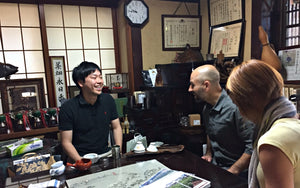
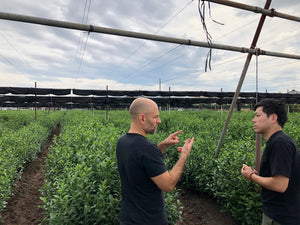
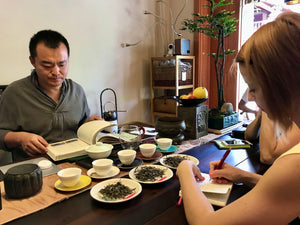
Our teas don't come from wholesale warehouses or unknown sources. We travel to the small producers we source from – whether it's a Japanese family tea garden, a Chinese mountain village or an oolong maker in Taiwan.
Stories
We meet them in person, learn their story, see how they care for their plants, and how they process the fresh leaves.
These experiences are the soul of our teas. This way, not only is the quality guaranteed, but also the fact that behind each cup there is a real person, a real story.
Direct
This direct relationship is valuable to us. Not only because of the excellent tea, but because we believe that trust, respect and personal presence are what make the tea drinking experience truly special.
Teavolution Tea Blog

Shincha - Japan's First Tea of Spring
Read more

What is shading in Japanese tea? | Matcha, Gyokuro, Kabusecha
Read more

Oct 2, 2025
Sencha tea
Read more
Sep 21, 2025
Matcha shortage in Japan
Read more
Mar 18, 2025
Puer tea, puerh or pu-erh
Read more
Mar 18, 2025
Types of tea
Read more
