
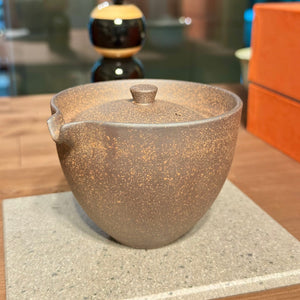


Duan Ni "Easy Gaiwan" - 160 ml
This easy gaiwan is one of the most practical tools for everyday gongfu tea drinking: made of Duan Ni (段泥) clay, fired at high temperatures. The design is both comfortable and reliable, making it ideal for beginners and experienced tea drinkers alike.
Why is Duan Ni clay good?
- Balancing effect: Duan Ni is generally a more porous, “breathable” clay that softens roughness , rounding out the mouthfeel while retaining heat well. It can be especially useful for sheng/shu puer and roasted oolongs. [Sources]
- Natural shade: the yellowish-beige tone and fine grain are characteristic of Duan Ni.
For whom and with what kind of tea?
- Recommended: sheng puer, oolong, red (black) tea – according to the distributor's recommendation.
- Based on experience: many tea lovers like to use Duan Ni for roasted oolong and shu puer because of its rounding effect.
Design & usability
- Built-in filter + pourer: the "easy" design catches the leaves and pours smoothly; a separate tea strainer is often not necessary.
- Comfortable grip: according to user feedback, it is safe to hold even when wet, and it heats up less to the hand than porcelain.
- Travel-friendly: fits in a small space, ideal for office or on-the-go gongfu.
Capacity & specifications
- Nominal capacity: 160 ml.
- User measurement: filled to the brim ~185 ml (for informational purposes, slight variations possible per piece).
- Firing: Dragon Kiln (high temperature).
- Material: Yixing Duan Ni clay.
Care & seasoning
- Clay gently absorbs the aromas of tea , so it is advisable to dedicate it to 1 tea style (e.g. sheng puer or roasted oolong).
- After use , rinse with hot water and dry open. Do not use detergent .
Why will you love me?
- Reliable pouring and filtering – a convenient, easy experience with every cup.
- Due to the rounding effect of Duan Ni, it gives a friendlier, softer sip than many teas.
- An excellent value for money entry into the world of clay tools.
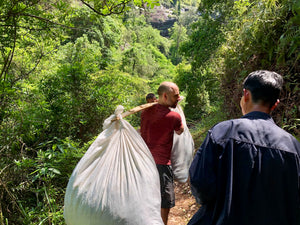
Personal contact
Our teas don't come from wholesale warehouses or unknown sources. We travel to the small producers we source from – whether it's a Japanese family tea garden, a Chinese mountain village or an oolong maker in Taiwan.
Stories
We meet them in person, learn their story, see how they care for their plants, and how they process the fresh leaves.
These experiences are the soul of our teas. This way, not only is the quality guaranteed, but also the fact that behind each cup there is a real person, a real story.
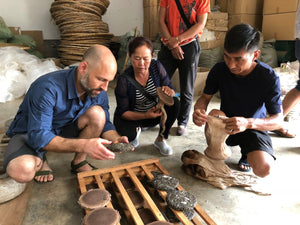
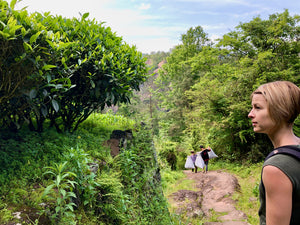
Direct
This direct relationship is valuable to us. Not only because of the excellent tea, but because we believe that trust, respect and personal presence are what make the tea drinking experience truly special.
Teavolution Tea Blog

Shincha - Japan's First Tea of Spring
Read more

What is shading in Japanese tea? | Matcha, Gyokuro, Kabusecha
Read more

Oct 2, 2025
Sencha tea
Read more

Sep 21, 2025
Matcha shortage in Japan
Read more
Mar 18, 2025
Puer tea, puerh or pu-erh
Read more
Mar 18, 2025
Types of tea
Read more
