


Tokoname "Junzō saku" – Black-Brown and White Gradient Flat Kyusu, 100 ml
The dark black-brown surface slowly lightens to off-white, as if the first light of dawn appears on the horizon of the night sky. The subtle color gradient and the low, wide-spread form of the teapot are elegant and special.
This 100 ml Tokoname kyusu is a tool for finely tuned, concentrated infusions. It is particularly well-suited for gyokuro, kabusecha, and high-quality sencha, when umami, silky texture, and the subtle nuances of the tea are in focus.
Crafted by Junzō – 淳蔵作
The inscription 淳蔵作 on the bottom of the teapot means "Made by Junzō". The term saku (作) is the maker's mark on Japanese handicrafts, directly connecting the object to its creator.
The teapot is the work of Tokoname ceramist Maekawa Junzō. His style is characterized by functionality, clean proportions, and sensitive experimentation with different clays and surfaces.
Flat shape for more precise extraction
The hira-gata, or wide and flat design, allows the tea leaves to spread freely and evenly across the bottom of the teapot. The water contacts a large surface area of the leaves, which promotes the controlled release of rich umami, sweetness, and creamy texture.
Through the particularly wide opening, it is easy to observe how the leaves slowly unfold during infusions. This is not only a beautiful part of the tea ceremony but also facilitates cleaning the teapot and removing the leaves.
Built-in ceramic sasame filter
The teapot is made with a built-in, finely perforated ceramic sasame filter. Its wide surface allows for quick and even pouring, while naturally retaining the leaves.
The ceramic filter does not impart any foreign, metallic taste to the tea and, with careful pouring, works well even with finer Japanese green teas.
Usage advice
The flat kyusu is a precise, sensitive tool. Due to its low form, pouring should be started slowly, with a steady motion. After a few uses, the teapot's center of gravity and flow will feel natural in the hand.
At the end of each infusion, pour out every last drop. If no water remains on the leaves, the next infusion will retain its clean, sweet, and distinct character.
Recommended preparation
Gyokuro
-
4–6 g tea leaves
-
50–60 °C water
-
90–150 seconds
-
smaller, concentrated infusions
Sencha
-
3–4 g tea leaves
-
70–75 °C water
-
60–75 seconds
Short, multiple infusion preparation
-
4 g tea leaves
-
65–75 °C water
-
first infusion: 30–45 seconds
-
gradually increase subsequent steeping times
These values are starting points. The small capacity allows for experimentation with temperature and steeping time in a precisely controllable manner, using less water.
Care
After use, rinse with clean, warm water, then leave to air dry completely without the lid.
Detergent and dishwasher use are not recommended. Quick rinsing and thorough drying help maintain the teapot's clean surface and natural character.
Technical specifications
-
Capacity: approx. 100 ml
-
Origin: Tokoname, Aichi Prefecture, Japan
-
Maker: Maekawa Junzō (前川淳蔵)
-
Mark: Junzō saku – 淳蔵作
-
Shape: flat, wide hira-gata
-
Filter: built-in ceramic sasame filter
-
Overall width: approx. 16 cm, including handle
-
Height: approx. 6.5 cm
-
Color: dark black-brown and white gradient
Each teapot is a handmade piece, so the blending of colors, the depth of shades, as well as the size and actual capacity may vary slightly. These small differences are not flaws but rather traces of artisanal craftsmanship: this is what makes each piece unique.
Personal contact
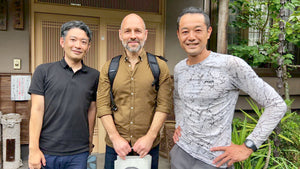
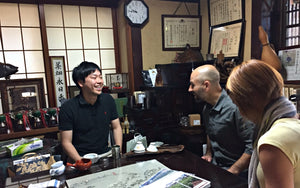
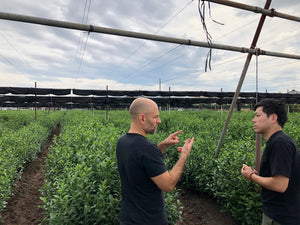
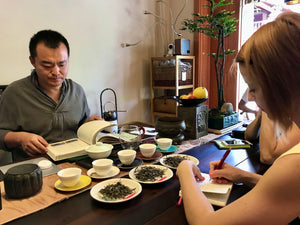
Our teas don't come from wholesale warehouses or unknown sources. We travel to the small producers we source from – whether it's a Japanese family tea garden, a Chinese mountain village or an oolong maker in Taiwan.
Stories
We meet them in person, learn their story, see how they care for their plants, and how they process the fresh leaves.
These experiences are the soul of our teas. This way, not only is the quality guaranteed, but also the fact that behind each cup there is a real person, a real story.
Direct
This direct relationship is valuable to us. Not only because of the excellent tea, but because we believe that trust, respect and personal presence are what make the tea drinking experience truly special.
Teavolution Tea Blog

Shincha - Japan's First Tea of Spring
Read more

What is shading in Japanese tea? | Matcha, Gyokuro, Kabusecha
Read more

Oct 2, 2025
Sencha tea
Read more

Sep 21, 2025
Matcha shortage in Japan
Read more
Mar 18, 2025
Puer tea, puerh or pu-erh
Read more
Mar 18, 2025
Types of tea
Read more
