


"Left-handed" Tokoname kyusu teapot
Tax included
Shipping calculated at checkout
Left-handed brown Tokoname kyusu – 300 ml
Most Japanese side-handle teapots are designed for right-handed use. However, this brown Tokoname kyusu subtly reverses the usual order of form: its handle is positioned so that the pot can be held naturally, steadily, and precisely with the left hand.
It is not only a unique piece but also a truly practical tool for those who have previously tried to adapt their movements to right-handed kyusu.
Interestingly, it can be used not only by left-handers but also by right-handers, in which case you pour away from yourself, rather than towards yourself.
Comfortable design for left-handed tea drinkers
The long, sideways handle provides a secure grip, while pouring can be done with an effortless and well-controlled wrist movement. The placement of the spout and handle creates a natural balance for left-handed use, allowing the pot to be comfortably guided even when full.
This is particularly valuable when preparing Japanese teas, where a quick, even, and complete pour significantly influences the taste of the next infusion.
Spacious shape for leaves to unfurl
The pot's lower, wide body provides ample space for the leaves of Japanese green teas. Sencha, bancha, or hojicha leaves can open up more freely, and the water can permeate them more evenly.
The 300 ml volume is larger than that of classic pots used for concentrated gyokuro preparation, making it ideal for everyday tea drinking, preparing two or three smaller cups, or serving several guests.
Warm, natural Tokoname character
The deep, reddish-brown surface beautifully highlights the pot's classic, restrained form. Instead of ornamentation, the focus is on proportions, material, and beauty derived from use.
The unglazed ceramic surface evolves with time: with regular use, it can subtly change, increasingly bearing the traces of tea sessions. For this reason, it is worth using primarily for one family of teas – such as Japanese green teas.
What teas do we recommend it for?
The size and shape of the pot are particularly well-suited for:
- sencha and fukamushi sencha,
- bancha,
- genmaicha,
- hojicha,
- as well as lighter Japanese teas prepared with larger volumes of water.
The 300 ml volume allows for multiple cups of tea to be made at once, while the kyusu maintains the precise, multi-infusion usability characteristic of Japanese tea drinking.
Usage suggestion
For sencha, as a starting point, use about 6–8 grams of tea leaves with 250–300 ml of 70–75 °C water. The first infusion time can be 45–75 seconds, depending on the type of tea.
Completely empty the pot at the end of each infusion. The last drops are often the most concentrated, and if no water remains on the leaves, the next infusion will also stay clean and balanced.
Care
After use, remove the leaves, then rinse the pot with clean, warm water. Dish soap and dishwasher use are not recommended, as fragrances and detergent residues can affect the natural character of the ceramic.
Leave the pot to air dry completely, without its lid, in a well-ventilated place.
Technical specifications
Volume: approx. 300 ml
Type: left-handed, side-handle kyusu
Origin: Tokoname, Aichi Prefecture, Japan
Material: unglazed Tokoname ceramic
Color: deep, reddish-brown
Recommended use: for Japanese green teas, for 1–3 people

Personal contact
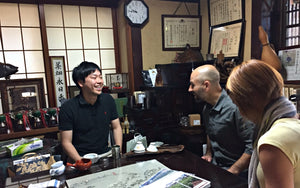
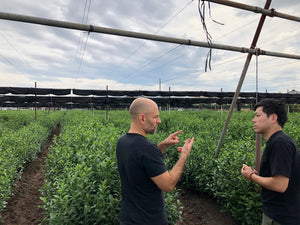
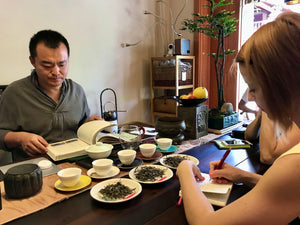
Our teas don't come from wholesale warehouses or unknown sources. We travel to the small producers we source from – whether it's a Japanese family tea garden, a Chinese mountain village or an oolong maker in Taiwan.
Stories
We meet them in person, learn their story, see how they care for their plants, and how they process the fresh leaves.
These experiences are the soul of our teas. This way, not only is the quality guaranteed, but also the fact that behind each cup there is a real person, a real story.
Direct
This direct relationship is valuable to us. Not only because of the excellent tea, but because we believe that trust, respect and personal presence are what make the tea drinking experience truly special.
Teavolution Tea Blog

Shincha - Japan's First Tea of Spring
Read more

What is shading in Japanese tea? | Matcha, Gyokuro, Kabusecha
Read more

Oct 2, 2025
Sencha tea
Read more
Sep 21, 2025
Matcha shortage in Japan
Read more
Mar 18, 2025
Puer tea, puerh or pu-erh
Read more
Mar 18, 2025
Types of tea
Read more
