


Shino tall 'wood fired' kyusu teapot
Tax included
Shipping calculated at checkout
OYU Ceramics – high kyusu shino glaze
There is an object that is not just a “tool”, but also gives rhythm. This high-shaped kyusu is exactly that: in a stable hand, with a clean pour, and with a surface that speaks silently.
Why is “high” kyusu good?
The higher-bodied kyusu gives the leaves more “depth”: the movement of water and tea is more disciplined, the infusion is even, and the pouring is easy to control. This is especially helpful when making more delicate Japanese greens, where a few degrees and a few seconds can be crucial.
Shino glaze – handwriting of fire
Shino is an iconic glaze type in the Japanese ceramic world: often with creamy white surfaces, orange “cloudy” tones, and small textures that bring the object to life. Historically associated with 16th century Japan, the Mino region, it is a famously “temperamental” glaze: the kiln atmosphere, the heat curve, and the glaze thickness all leave their mark on it – which is why no two pieces are exactly the same.
Material use and practicality
OYU kyusu are handcrafted, high-fired stoneware pieces; for teaware intended for use, it is of particular value if the shape is not only beautiful, but also pours well , and the lid fits securely. The built-in clay filter characteristic of kyusu helps to keep the cup clean, while pouring can be fast and precise.
What teas do we recommend?
- Sencha – for a clean, fresh green character with a controlled pour
- Gyokuro – at lower temperatures, for umami, silky toppings
- Japanese red (wakocha) / milder black teas – for round, elegant cups
- Oolong (lighter oxidation) – if you like shorter, multiple infusions
Preparation starting points
Sencha
- Ratio: 2–3 g / 100 ml
- Water: 70–75 °C
- Time: 60–75 seconds
Gyokuro
- Ratio: 4–6 g / 100 ml
- Water: 50–60 °C
- Time: 90–150 sec.
Wakocha / milder black teas
- Ratio: 2–3 g / 100 ml
- Water: 85–95 °C
- Time: 60–120 sec.
Care – to keep it beautiful for a long time
- Before use (especially for the first time), rinse with warm water and then let it dry completely.
- Hand washing recommended: rinse with clean water, no chemicals.
- Avoid dishwashers and scented detergents.
- After use, leave it to dry without a lid so that no moisture remains inside.
Note: Due to the nature of shino glaze, the shades, mottling, “fire marks” and subtle textures of the surface may vary from piece to piece – this is not an error, but the most beautiful signature of artisanal firing.

Personal contact
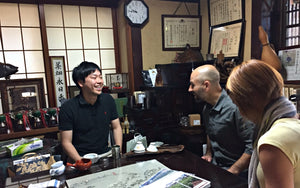
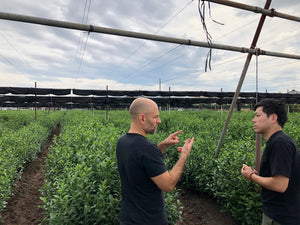
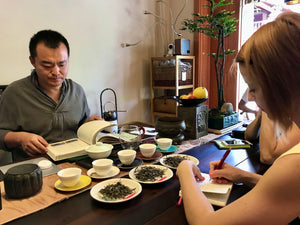
Our teas don't come from wholesale warehouses or unknown sources. We travel to the small producers we source from – whether it's a Japanese family tea garden, a Chinese mountain village or an oolong maker in Taiwan.
Stories
We meet them in person, learn their story, see how they care for their plants, and how they process the fresh leaves.
These experiences are the soul of our teas. This way, not only is the quality guaranteed, but also the fact that behind each cup there is a real person, a real story.
Direct
This direct relationship is valuable to us. Not only because of the excellent tea, but because we believe that trust, respect and personal presence are what make the tea drinking experience truly special.
Teavolution Tea Blog

Shincha - Japan's First Tea of Spring
Read more

What is shading in Japanese tea? | Matcha, Gyokuro, Kabusecha
Read more

Oct 2, 2025
Sencha tea
Read more
Sep 21, 2025
Matcha shortage in Japan
Read more
Mar 18, 2025
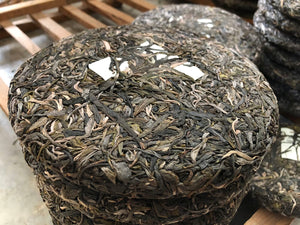
Puer tea, puerh or pu-erh
Read more
Mar 18, 2025
Types of tea
Read more
