


"Shibokyusu" Tokoname teapot
Tax included
Shipping calculated at checkout
Pickup currently unavailable
Tokoname "Junzō saku" (淳蔵作) - flat kyusu, 90 ml
There comes a point where tea drinking is no longer “pot + hot water” but fine-tuning. This 90ml, white, flat kyusu was born for that: short, concentrated pours where umami, sweetness and a clean finish come into focus.
What does the sign mean? – 淳蔵作
The marking on the bottom of the jug can be interpreted as follows: Made by Junzō (淳蔵) (作) . “Saku” (作) is the signature of the creator in the world of Japanese ceramics: simple, objective – and therefore elegant.
Form that shapes taste
The wide, flat body helps to spread the leaves evenly and ensure that the water works equally at all points. This is especially beneficial for gyokuro and high-quality sencha , where umami extraction and a controlled, silky texture are the goals.
Ceramic filter – clean cup, natural materials
The kyusu is made with a built-in ceramic filter that delivers quick pouring and a clean drink without a metallic taste. It's ideal for everyday sencha and a stable companion even when working with finer, more friable leaves.
Usage tip for flat kyusu
One of the beauties of flat molds is that they are very “precise” tools – in return they require a delicate, slower pouring . Start carefully and after a few cans the movement will become instinctive.
Recommended preparation (starting points)
Gyokuro (for 90 ml kyusu)
- 4–6 g leaves
- 50–60 °C water
- Soak for 90–150 seconds
- Tip: pour everything out, no water remains on the leaves - this way the next infusion will remain clean and sweet.
For Sencha (classic, pure green)
- 3 g leaves
- 70–75 °C water
- 60–75 sec soaking
Short, multi-updo style (if you like layers)
- 4 g leaves
- 65–75 °C water
- 30–45 seconds , then gradually increase
Care to keep it beautiful for a long time
- After use, rinse with water only and then let it dry completely without a lid.
- Do not use a dishwasher or scented detergent.
- If you rinse it quickly after drinking tea, the kettle will retain its clean character for a long time.
Technical data
- Capacity: approx. 90 ml
- Origin: Tokoname, Aichi, Japan
- Creator: Junzō (淳蔵) – “Junzō saku” (淳蔵作)
- Size: approx. Ø10 cm × 4.5 cm (ear approx. 4.5 cm)
- Filter: ceramic
Note: each piece is handmade, so color tone, dimensions, and actual volume may vary slightly - this makes it a truly "living" object.
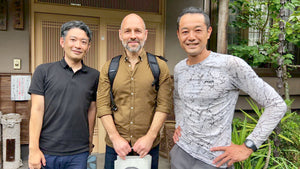
Personal contact
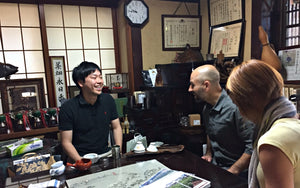
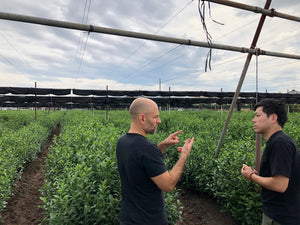
Our teas don't come from wholesale warehouses or unknown sources. We travel to the small producers we source from – whether it's a Japanese family tea garden, a Chinese mountain village or an oolong maker in Taiwan.
Stories
We meet them in person, learn their story, see how they care for their plants, and how they process the fresh leaves.
These experiences are the soul of our teas. This way, not only is the quality guaranteed, but also the fact that behind each cup there is a real person, a real story.
Direct
This direct relationship is valuable to us. Not only because of the excellent tea, but because we believe that trust, respect and personal presence are what make the tea drinking experience truly special.
Teavolution Tea Blog

Shincha - Japan's First Tea of Spring
Read more

What is shading in Japanese tea? | Matcha, Gyokuro, Kabusecha
Read more

Oct 2, 2025
Sencha tea
Read more
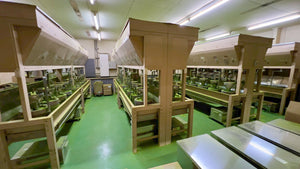
Sep 21, 2025
Matcha shortage in Japan
Read more
Mar 18, 2025
Puer tea, puerh or pu-erh
Read more
Mar 18, 2025
Types of tea
Read more
