
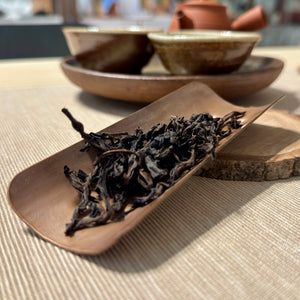


Spicy, deep and elegant, Rou Gui is a classic oolong from the rock canyons of Wuyishan: layers of warm cinnamon, mineral sweetness and subtle charcoal roast meet in the cup. The result is a silky, lingering finish – the famous yan yun , the “rhyme of the rocks”.
Origin & processing
Rou Gui is a variety grown in Wuyishan, its name literally means “cassia/cinnamon” – hence the spicy aroma. After sorting, the leaves are prepared in the Wuyi style: rolling, sha qing (enzyme inhibition) and multi-stage, traditionally charcoal-roasted ; the tea is rested between roasts to achieve a round, clean flavor. Wuyishan growing areas are often designated as zhengyan (inner cliff region), banyan (peripheral terroir) and waishan (outer mountains) – this classification is also key to understanding the mineral character and value. The famous Matou (Ma Tou, “horse head”) section is known for its particularly sought-after Rou Gui teas.
- “Rou Gui” = cassia/cinnamon, Wuyishan, Fujian.
- Traditional, multi-round charcoal roasting in a bamboo basket.
- Terroir designations: zhengyan , banyan , waishan .
Flavor profile
- Aroma: warm cassia/cinnamon, slight floral.
- Taste: hints of cocoa, roasted nuts, caramel, black fruits; clean, dry minerality.
- Texture: silky, full-bodied, with a long echoing yan yun .
- Finish: sweet-mineral, with a subtle spiciness.
Recommended preparation
Asian (gongfu) method: 6 g / 150 ml, 90–95 °C. awakening: 1 short, then 10–15 second first pour, then gradually increase. 5–8 pours also maintain the aroma nicely.
Western method: 3–4 g / 250 ml, 92–95 °C, 2:30–3:00 minutes. Produces a clean, round, cocoa-mineral cup.
Pairing & occasion
For cooler days, for afternoon meditation; dark chocolate (70–80%), nut-seed cookies, or even a natural, long-aged cheese go well with it.
Why do we love it?
Because Rou Gui expresses the character of rock oolongs "in one sentence": a spicy-sweet aroma, deep minerality, elegantly roasted tones and an infinitely clean finish.
Personal contact
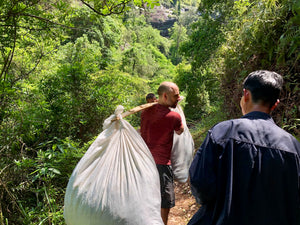
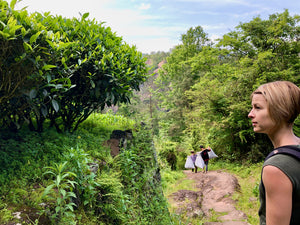
Our teas don't come from wholesale warehouses or unknown sources. We travel to the small producers we source from – whether it's a Japanese family tea garden, a Chinese mountain village or an oolong maker in Taiwan.
Stories
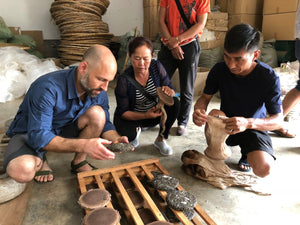
We meet them in person, learn their story, see how they care for their plants, and how they process the fresh leaves.
These experiences are the soul of our teas. This way, not only is the quality guaranteed, but also the fact that behind each cup there is a real person, a real story.
Direct
This direct relationship is valuable to us. Not only because of the excellent tea, but because we believe that trust, respect and personal presence are what make the tea drinking experience truly special.
Teavolution Tea Blog

Shincha - Japan's First Tea of Spring
Read more

What is shading in Japanese tea? | Matcha, Gyokuro, Kabusecha
Read more

Oct 2, 2025
Sencha tea
Read more

Sep 21, 2025
Matcha shortage in Japan
Read more
Mar 18, 2025
Puer tea, puerh or pu-erh
Read more
Mar 18, 2025
Types of tea
Read more
