


Kumaen Okuyutaka Sencha - Yame, Fukuoka
A uniformly green, clean brew, full umami and silky mouthfeel - the precise work of the Kumaen family's mountain plantations meets the expressive, balanced character of the Okuyutaka cultivar (tea plant variety). An everyday "peak sencha" that brings the deep sweetness typical of the Yame region.
Okuyutaka (おくゆたか) – a later-harvested, umami-rich sencha variety
Okuyutaka (おくゆたか) is a mid-late sencha cultivar registered in 1983 at the Kanaya Tea Experiment Station. It is unique in that it is not a Yabukita bloodline , so it tells a different story in the cup: gentle, clean umami , a different aroma character, and a distinctly “round” balance.
Origin, name, character
" Oku " (奥) refers to the later development of the variety, while " Yutaka " (豊か) commemorates the parent Yutakamidori (ゆたかみどり) . Okuyutaka is also known for its higher yield and is described as having good cold tolerance and lower disease susceptibility.
“Family Tree” – where did Okuyutaka come from?
A quick overview – just as much genetics as you can take in with a smile.
 Selected from Asatsuyu (あさつゆ) seeds (1949)
 │
└── Yutakamidori ゆたかみどり ♀
 ×
 Tamamidori (Zairai of Kyoto) ───┐
 ├── Cha-Hon F1NN8 茶本F1NN8 ♂
 Shizuoka Zairai No.6 静岡在来6号 ─┘
 │
 └── Okuyutaka おくゆたか
(茶農林34号 – “tea plant No.34”)
Plant properties – what you can "read" in the garden
- Intermediate growth form , with well-developed stems and many branches.
- Good rooting – can also be reliably grown from cuttings.
- Shiny, slightly wrinkled, rounded leaves; thicker character in several places compared to Yabukita
- Longer shoots, darker green fresh leaves;
Harvest time and yield – the “work organizer” advantage
Okuyutaka typically buds about 8 days after Yabukita, and first harvest is about 6 days later. The yield is higher than Yabukita in many places (on average, about ~50% more is reported, and even more under certain conditions). This later timing can also be well-suited to other varieties, making the season more even.
Why do they like it?
One of the most beautiful messages of Okuyutaka in the cup: a mild, umami-rich taste, and a different aromatic character compared to the typical Yabukita-dominant profile. According to the descriptions, the amino acid content is particularly high (in tests compared to Yabukita), while the catechins are slightly lower and the caffeine can be higher - making the sip both "soft" and lively.
Where does this breed feel comfortable?
Its cold tolerance and stability are often highlighted, so it can be an interesting choice, especially south of the Tokai region, in the southern parts of Shizuoka, and even in cooler, mountainous areas - where spring cold still has its say.
Our Okuyutaka Sencha - Origin & Producer
- Producer: Kumaen (Yame, Fukuoka) – multi-generational family tea farm
- Cultivar: Okuyutaka (late ripening, high umami potential, lower tannin sensation)
- Region: foggy mornings, large daily temperature fluctuations; clean, sweet profile typical of Yame senchas
- Processing: gentle steaming (often asamushi), careful twisting and drying
Taste and aroma profile
- Aroma: sweet-umami vegetable notes (edamame, steamed spinach), nori/kombu, fresh grass
- Taste: deep umami, creamy sweetness; green almond, milky/creamy nuances with a delicate freshness
- Body & finish: medium-full, smooth sip; long, sweet-mineral aftertaste
When do we recommend it?
For both morning focus and afternoon relaxation. Okuyutaka is a clean, reliable “comfort-sencha”: stable umami, little bitterness, harmonious sweetness.
Preparation instructions
Asian (kyusu/gongfu) method
- Equipment: Japanese jug (kyusu) 120–200 ml
- Tea: 5–6 g
- Water: 70–75 °C (soft water is preferred)
- 1st pour: 60–80 sec.
- 2nd–3rd pour: 20–40 seconds, then gradually increase
- Tip: Creamier and more umami at around 70 °C, fresher and greener at 75 °C.
Western method
- Equipment: 300–350 ml cup or jug with strainer
- Tea: 3–4 g
- Water: 75–80 °C
- Soaking: 1:30–2:00 minutes; 1–2 shorter infusions can be made from the same batch
Cold brew
- Ratio: 8–10 g/liter
- Time: 6–8 hours in the refrigerator
- Result: a silky, very low bitterness, sweet-umami drink with fresh green tones
Tips & Pairing
- Water: soft, low TDS (≈20–80 ppm) enhances umami and clarity
- Food pairing: lightly salty snacks (nori, toasted seeds), fresh goat cheese, rice balls (onigiri)
- Storage: Protect from light and odors, airtight; keep refrigerated after opening

Personal contact
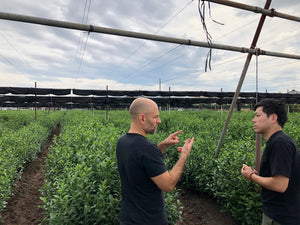
Our teas don't come from wholesale warehouses or unknown sources. We travel to the small producers we source from – whether it's a Japanese family tea garden, a Chinese mountain village or an oolong maker in Taiwan.
Stories
We meet them in person, learn their story, see how they care for their plants, and how they process the fresh leaves.
These experiences are the soul of our teas. This way, not only is the quality guaranteed, but also the fact that behind each cup there is a real person, a real story.

Direct
This direct relationship is valuable to us. Not only because of the excellent tea, but because we believe that trust, respect and personal presence are what make the tea drinking experience truly special.
Teavolution Tea Blog

Shincha - Japan's First Tea of Spring
Read more

What is shading in Japanese tea? | Matcha, Gyokuro, Kabusecha
Read more

Oct 2, 2025
Sencha tea
Read more

Sep 21, 2025
Matcha shortage in Japan
Read more
Mar 18, 2025
Puer tea, puerh or pu-erh
Read more
Mar 18, 2025
Types of tea
Read more
